
The cake gets cut, the candles go out, and then comes the moment every party planner hopes to avoid: a room full of kids asking, “What do we do now?” A smart party entertainment comparison starts there. The best birthday activity does more than fill an hour. It gives guests a reason to jump in, make memories together, and leave with something more exciting than a goodie bag stuffed with forgettable trinkets.
For preschoolers through middle-schoolers, entertainment is often the centerpiece of the celebration. But not every option delivers the same kind of energy, convenience, or replay value. A bounce house can burn energy. A movie party can feel cozy. A hands-on experience can turn every guest into the star of the show. The right pick depends on your child, your guest list, your space, and the kind of celebration you want everyone talking about on Monday morning.
What Makes Party Entertainment Feel Worth It?
Parents are not only choosing an activity. They are choosing the pace of the party, the amount of setup involved, and whether the fun holds up after the first ten minutes. Great entertainment has a few things in common: kids understand it quickly, everyone gets a chance to participate, and there is enough structure to keep the celebration moving without making it feel overplanned.
The strongest options also work across different personalities. The high-energy kid wants to move. The creative kid wants to make something. The quieter guest wants a low-pressure way to join in. When the activity gives every child a role, you get fewer sidelines, fewer awkward pauses, and more real smiles in the photos.
A take-home element is another big win. Kids love leaving with proof of the fun, whether it is an art project, a personalized treat, or a creation they made from scratch. It stretches the party magic beyond the last slice of pizza.
Party Entertainment Comparison: What Fits Your Celebration?
There is no single “best” party format for every group. Here is how popular choices compare when you look beyond the initial wow factor.
Bounce houses and active play
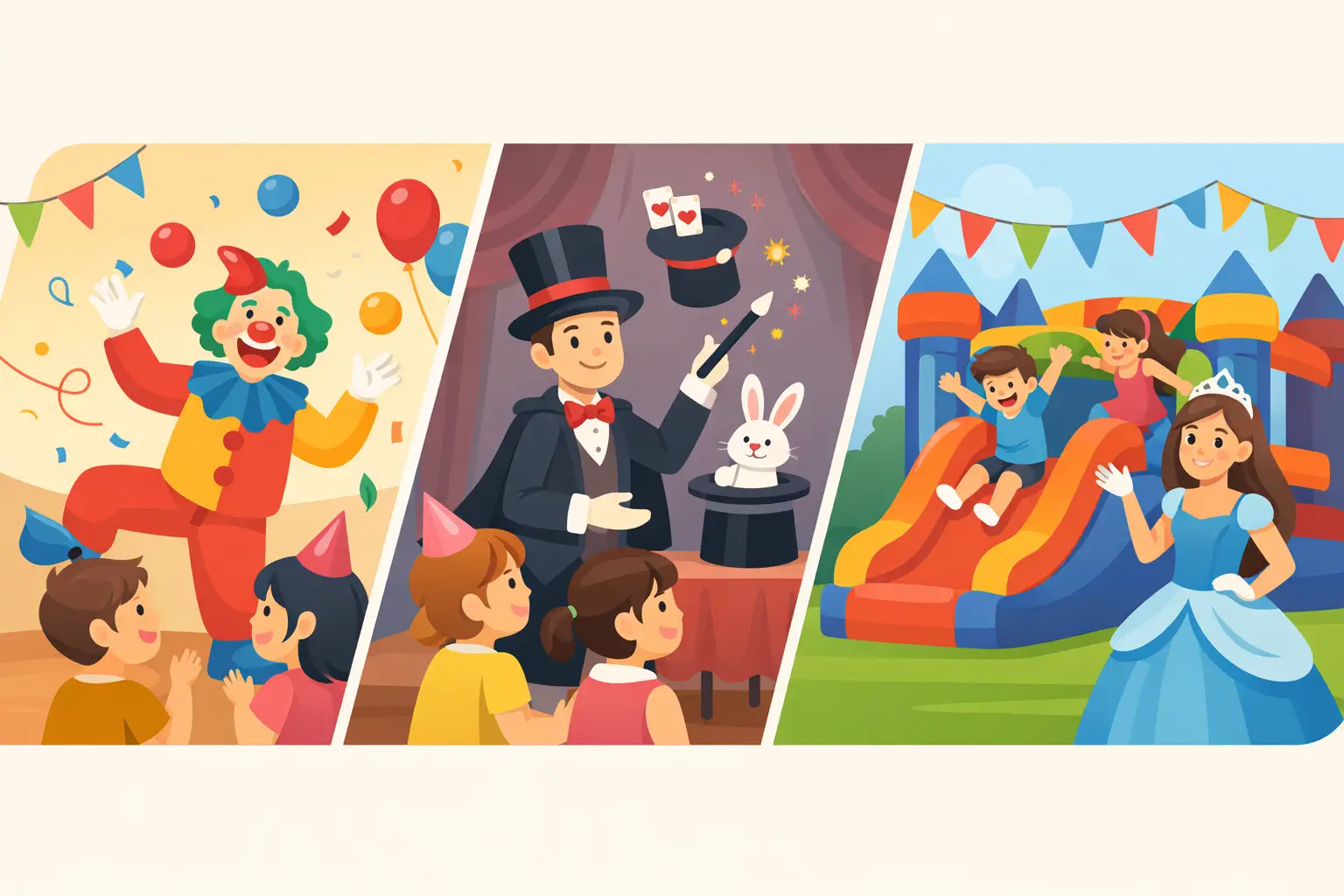
Inflatables, obstacle courses, and indoor play spaces are classic choices for a reason. They create instant excitement and help active guests burn off a serious amount of energy. For a large group of younger children, especially outdoors, they can be an easy fit.
The trade-off is that free-play entertainment can be hard to pace. Some kids may dominate the action while others hang back. Weather can complicate outdoor plans, and indoor venues may have height, sock, or supervision rules. There is also usually no personal keepsake beyond photos.
Choose active play when your birthday kid loves movement and your priority is a big, physical release of energy. It works especially well when there is plenty of room and a guest list that already knows one another.
Character performers, magic, and live shows
A performer gives the party a clear focal point. Magic shows, princess visits, animal encounters, and science demonstrations can create a major reveal moment, particularly for younger children. Parents also appreciate that someone else is leading the room for a while.
The limitation is participation. Guests may be delighted spectators, but only a few children are usually invited to help with the trick, meet the character, or hold the animal. The experience can also be highly age-dependent. What feels magical at five may feel too young for an eight-year-old who wants to be in on the action.
This route shines when your child has a specific character obsession or when you want entertainment that asks very little of guests. It is a strong choice for mixed-age family parties where adults want to relax and watch the show too.
Arcade, bowling, and game-based venues
For older kids and tweens, game-focused parties offer built-in excitement and a social atmosphere. Bowling lanes, arcade cards, laser tag, and similar venues are easy to understand, and their food packages can make planning feel wonderfully simple.
Still, games can split a party into mini-groups. One guest may be thrilled by competition while another runs out of tokens or feels left behind in a fast-paced game. Costs can climb when upgrades, extra credits, food, and prizes enter the picture. The kids may have fun, but the experience is not always equally personal.
Game venues make sense for competitive groups, older guests, and kids who want a lively hangout more than a guided activity. Ask how the venue keeps the whole party connected, not just entertained separately.
Craft parties and hands-on making
Hands-on parties bring together the best parts of play and creativity. Instead of watching entertainment happen, kids mix, choose, decorate, build, and show off their own ideas. A guided project naturally gives the party a beginning, a middle, and a satisfying finish.
The key is choosing an activity that is genuinely fun to make, not a project that feels like school art class. The materials should feel special, the instructions should be simple enough for the youngest guests, and the finished creation should be something children are excited to carry home.
Slime-making brings that formula to life in a delightfully squishy way. Guests can mix colors, stretch textures, add scents, swirl in charms, and create a custom slime that is completely theirs. At The Slime Kitchen, the sensory fun is paired with a polished, guided experience, so parents get structure while kids get to fire up their senses.
This option is especially strong for groups with varied energy levels. The social butterfly can narrate every glittery choice. The thoughtful creator can take time finding the perfect color combination. Everyone ends up with a take-home creation, and every creation looks a little different.
How to Choose Based on Your Guest List
Before booking, think about how the children will actually interact. Age matters, but group chemistry matters just as much. A party of six close friends may love a detailed project or escape-style challenge. A group of 20 energetic classmates may need an activity with clear stations, a host, and lots of opportunities to engage at once.
For preschool and early elementary ages, look for simple instructions, frequent transitions, and plenty of tactile or visual excitement. Kids in this range tend to love activities they can touch, pour, squish, and proudly show a parent afterward.
For older elementary kids, personalization becomes more powerful. They want choices that feel like theirs: bold colors, themed add-ins, funny names, and a little friendly comparison of whose creation is the fluffiest, glossiest, or most extra. For tweens, avoid anything that feels babyish. Trend-aware themes and an experience that looks great in photos can make all the difference.
Also consider guests with different comfort levels. A great activity should not require a child to perform in front of everyone to enjoy it. Hands-on formats are often easier for shy guests because they can participate at their own station while still sharing the moment with the group.
The Parent Checklist That Actually Matters
Price is part of the decision, but value is bigger than the package total. Ask what is included in the experience and what you will need to supply yourself. A lower starting price can quickly change if you are responsible for decorations, setup, cleanup, party favors, or keeping kids occupied between activities.
Think through these practical details before you commit:
- How much of the party timeline is led by staff versus managed by you?
- Does every guest participate at the same time, or will children spend time waiting?
- Is there a weather risk, a messy cleanup, or a complicated setup plan?
- Can the activity work for different ages, abilities, and personalities?
- Do guests leave with a meaningful keepsake or only a temporary thrill?
The answer does not need to be perfect in every category. A backyard bounce house may be exactly right for a summer party with a very active birthday kid. A live performer may be the dream choice for a character-themed celebration. But if you want a creative, screen-free activity that doubles as entertainment and a party favor, a guided making experience earns serious consideration.
Make the Entertainment Part of the Memory
The most shareable parties are not necessarily the loudest or the most expensive. They are the ones where guests have something to do together, something to laugh about, and something personal to bring home. That might be a wild neon slime with too many charms, a photo of friends comparing stretchy creations, or the proud announcement that someone invented the “birthday cake cloud” texture.
Choose entertainment that gives your child space to be themselves. When the activity lets every guest mix, stretch, squish, create, and celebrate in their own style, the party does not just pass the time. It becomes the part everyone remembers.